
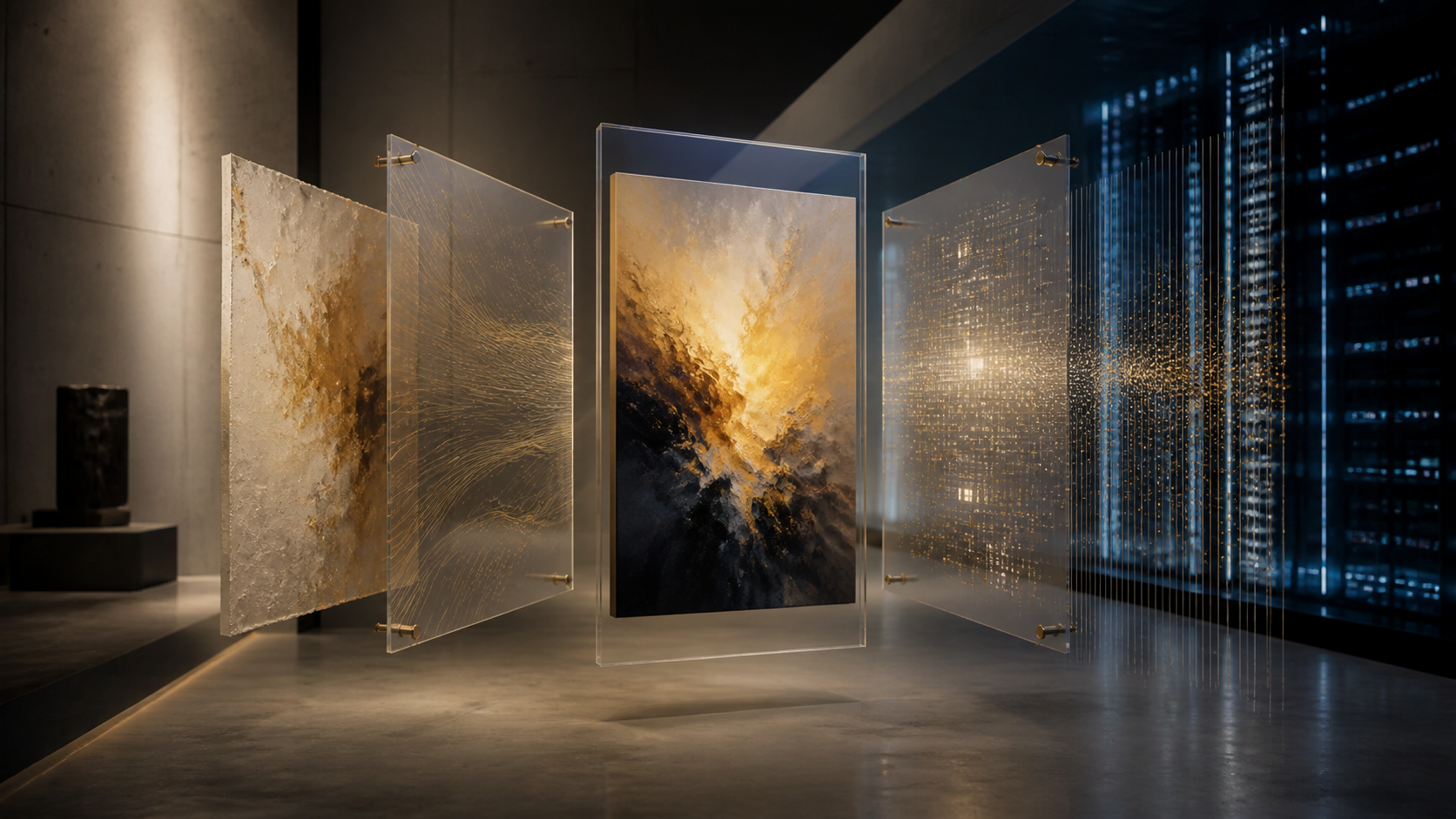
The question “Was this made by AI?” sounds precise. In practice, it can describe almost nothing.
One artist may use a generative model to produce an entire starting image. Another may train a small model on a hand-built dataset, select a fragment, repaint it and rebuild the composition manually. A third may use an AI tool only to remove dust from a scan or test variations that never appear in the final work. Applying the same label to all three processes does not create transparency. It removes the distinctions that make transparency useful.
For galleries, institutions and collectors, the more practical question is not whether AI appeared somewhere in the process. It is what the tool did, where human judgement entered, which version the artist approved and what evidence remains available for later inspection.
This is not an argument against disclosure. It is an argument for disclosure that respects the complexity of creative work.
A binary label confuses tool use with authorship
Artists have always worked through layered processes: cameras, darkrooms, code, found material, assistants, fabrication studios and software all complicate the idea that a work is simply “made by” one isolated hand. Generative systems add new questions, but they do not make every creative decision disappear.
The British Council’s Why technology needs artists report frames artists as active participants in technological development, not merely end users. Its international evidence shows artists testing technical limits, creating new knowledge and bringing cultural and human values into emerging systems. That perspective matters because a disclosure system should make creative agency more legible, not replace it with a generic machine label.
For an AI-assisted artwork, useful context might include whether the model generated the primary visual material, whether it transformed an artist-supplied image, whether a bespoke dataset shaped the output, whether the artist selected among many results, and whether later compositing, drawing, animation or physical fabrication changed the work substantially.
No public record needs to expose every prompt, failed experiment or private studio note. But it should avoid implying that a minor automated edit and a fully generated asset are the same event.
Content Credentials are becoming more specific
The C2PA technical specification provides a standard way to attach signed provenance information to digital content. Version 2.4, published in April 2026, introduced a machine-readable AI Disclosure assertion. The specification describes it as complementary to existing signals about actions and digital source type, adding structured information such as model provenance and human oversight level.
That is an important shift. It recognises that “AI was involved” is only the beginning of a meaningful description.
C2PA’s user-experience guidance makes the same point in plainer language. It warns that a statement such as “Made with AI” does not show whether an asset was fully generated or only partially edited. Without additional verifiable context, the label can confuse audiences and weaken trust.
Content Credentials do not decide authorship, artistic merit or legal rights. They can, however, help a compatible system preserve specific assertions about how an asset was created or changed and whether that signed record still validates. That turns a vague claim into information that can be examined.
Four questions make disclosure more useful
1. What changed?
The first question is about the asset, not the reputation of the tool. Did the system create the primary image, modify an existing work, generate an ingredient, interpolate frames, alter sound, or support a technical task that is not visible in the final piece?
This distinction is valuable at gallery intake. It helps a curator understand the relationship between the supplied file and the artist’s wider process without forcing the practice into a simple human-versus-machine category.
2. What did the artist decide?
Human oversight is not a ceremonial tick box. Selection, rejection, sequencing, editing, dataset construction, compositing, material translation and display design can all carry substantial creative judgement.
A useful record should therefore preserve the artist’s approved account of the process. That account may sit alongside machine-generated provenance, but the two are not interchangeable. Software can record that an action occurred; the artist explains why that action belongs to the work.
3. Which evidence can be verified?
Disclosure becomes stronger when a viewer can inspect more than a caption. A signed Content Credential may record source and editing assertions for a particular asset. An invisible watermark or other durable identifier may provide a route back to an authoritative artwork record if attached metadata is lost during ordinary distribution. A public verification page can translate those signals into language a gallery or collector can understand.
Each layer has limits. A valid signature shows that signed assertions remain bound to the asset and have not been silently altered; it does not prove that every statement is complete or that every right has been cleared. A responsible interface should make that boundary visible.
4. Who is the disclosure for?
An artist, conservator, curator and collector do not need identical views. The artist may need a detailed private production record. A gallery may need a concise intake summary and an approved exhibition version. A collector may need a durable public explanation of provenance. A researcher may need deeper process information, subject to the artist’s consent.
Good disclosure is progressive: enough context for the immediate decision, with a route to more detail where appropriate. Dumping every technical field onto a public page is not transparency if nobody can interpret it.
What this means for Miharana by Urticad
Miharana’s public product thesis combines invisible watermarking, signed C2PA provenance and public verification for digital art, followed by fiat-first commerce. In an AI-assisted context, those components should support a calm, creator-led explanation of process rather than a moralising badge.
The artwork record can identify the artist or authorised publisher, the approved asset and the public context supplied for the work. Content Credentials can preserve structured provenance that compatible tools can validate. A durable linkage signal can help reconnect a separated rendition to its record. Public verification can present what is known, what validates and what remains an artist-supplied statement.
This approach does not claim to settle every dispute about AI and art. It provides a better surface for asking the questions that galleries, institutions and collectors already face.
For artists, the benefit is agency: the ability to describe a practice without being reduced to a binary label. For galleries, it is a more disciplined intake conversation. For institutions, it is a clearer separation between machine-readable evidence, curatorial interpretation and private documentation. For investors assessing creative technology, it is evidence that the product understands a real workflow rather than chasing a fashionable label.
Better questions create better trust
AI-assisted art will continue to include radically different practices. Some will be model-led; others will use automation at the margins; many will combine code, image-making, performance, writing, sound and physical materials in ways that resist a single category.
Transparency should make those differences easier to understand. The strongest disclosure does not ask audiences to approve or reject a work because AI was present. It helps them see what happened, what the artist decided, which claims can be checked and where uncertainty remains.
That is a more demanding standard than “Made by AI”. It is also far more respectful of artists and far more useful to the institutions building confidence in digital work.
If you are an artist, curator, gallery or researcher working with AI-assisted practice, Urticad would value hearing which parts of the process audiences genuinely need to understand — and which should remain within the studio.