

AI Adoption Is Becoming a Creative Asset: What OpenAI’s 69-Page Report Means for Digital Artists
The most important finding in OpenAI’s new 69-page working paper is not that organisations are buying access to AI. It is that adoption keeps deepening after access begins.
How Organizations Use AI: Evidence from ChatGPT, released on 12 August 2026, studies privacy-preserving usage data from ChatGPT Enterprise. At the six-month adoption horizon, its worker-level sample covers more than 1,500 organisations and over 17 million messages. Across the wider enterprise sample, output tokens rose roughly sevenfold between June 2025 and March 2026. Among a consistent cohort of organisations that had already adopted by June 2025, output grew roughly fourfold.
In other words, obtaining the tool was only the starting point. Organisations continued to discover where AI belonged, which tasks deserved it and how to turn scattered individual experiments into repeatable capability.
The paper is about organisations, not artists, and it does not measure artwork prices, creator income or cultural influence. Its public-company analysis is descriptive rather than causal. But its adoption pattern offers a useful lens for digital art: artists who begin learning earlier may have more time to turn AI from a novelty into an accumulated creative and commercial asset.
That advantage is not automatic. It compounds only when practice, authorship and evidence mature together.
The real early-mover advantage is learning depth
OpenAI’s researchers document four broad facts. Enterprise use is growing rapidly; early public-company adopters tend to be larger and more invested in intangible and organisational capabilities; active use spans roles and seniority; and the work covers a wide range of tasks, including writing, technical work, communication, research and information synthesis.
The finding that matters for creators is the distinction between access and deployment. A subscription does not create a practice. A prompt does not create a body of work. Value emerges through co-invention: the slow process of discovering where a general-purpose technology genuinely improves the work, then building the complementary habits and systems around it.
OpenAI’s separate B2B Signals analysis makes the same point more directly. Firms at the frontier are not simply sending more messages. They are using AI for deeper work, providing richer context and embedding it more substantially into workflows. OpenAI calls the resulting gap a compounding frontier advantage, while also warning that token volume is not a direct measure of business value.
For an artist, depth can mean learning when generation is useful and when it weakens the idea; building a reliable way to move between sketch, model, edit, sound, motion and final master; understanding how to art-direct variability; and developing the judgement to reject plausible but generic results. The earlier this learning begins, the more iterations can accumulate behind the visible work.
That is a stronger advantage than simply being first to use a new model.
Three forms of compounding for digital artists
1. Creative capability compounds
Repeated use can create a personal operating system for making art. The artist develops a language for directing tools, a library of successful and failed approaches, a sharper sense of where human decisions matter and a faster path from concept to resolved work.
This does not make the machine the author. It makes the artist’s judgement more operational. Over time, a recognisable practice may emerge across still images, moving image, interactive work, editions and commissions. The competitive advantage is not unlimited output; it is the ability to produce coherent work across more surfaces without dissolving the artist’s point of view.
2. Commercial options compound
A mature AI-assisted workflow can expand the number of credible ways an artist brings work to market. One research process might support a finished 1/1 work, a commissioned variation, an exhibition sequence, an installation, a licensed moving-image adaptation or a documented studio edition. A coherent archive can also make it easier for curators, galleries and collectors to understand how individual works relate.
This is where earlier integration may strengthen monetisation potential. The artist has more time to learn which formats audiences value, which production costs can be reduced without lowering quality, and which offers fit the practice. They can build relationships and distribution while others are still treating AI as an occasional effect.
None of this guarantees sales or appreciation. More output can just as easily create noise, confuse authorship or weaken scarcity. The commercial advantage comes from clearer positioning and more valuable options, not volume alone.
3. The work’s evidential asset base compounds
Digital art is unusually dependent on context. A file rarely explains who made it, how AI participated, which version is authoritative, what was changed or what rights accompany a release. If those facts are reconstructed only at the point of sale, important evidence may already be missing.
Artists who integrate AI early can also integrate record-keeping early. They can preserve dated masters, process notes, tool roles, material source decisions, edit histories, approved renditions and release terms as the practice develops. The C2PA standard is designed to support cryptographically verifiable provenance information about how an asset was created and changed. It is not a judgement of artistic quality, but it can help make a work’s history more legible.
This is the part of the early-mover advantage that can influence the long-term asset character of a body of work. A collector, curator or institution is not asked to trust a detached image alone. They can encounter a consistent series, a documented creative process and a clearer chain between artist, work and authorised release.
What artists should integrate now
The practical response is not to automate everything. It is to build five complementary assets alongside the work:
- A repeatable creative workflow. Choose one meaningful part of the practice where AI expands the idea or removes a real production constraint.
- A decision record. Document the human direction, tool contribution, important edits and selection logic without turning every artwork into a technical manual.
- A coherent series. Let experiments accumulate into a recognisable body of work rather than an endless feed of unrelated tests.
- A rights and provenance layer. Keep creation evidence, master files, public verification and commercial permissions distinct but connected.
- A learning loop. Track which works create serious attention, enquiries, commissions, collector interest or institutional conversation, then deepen what is genuinely distinctive.
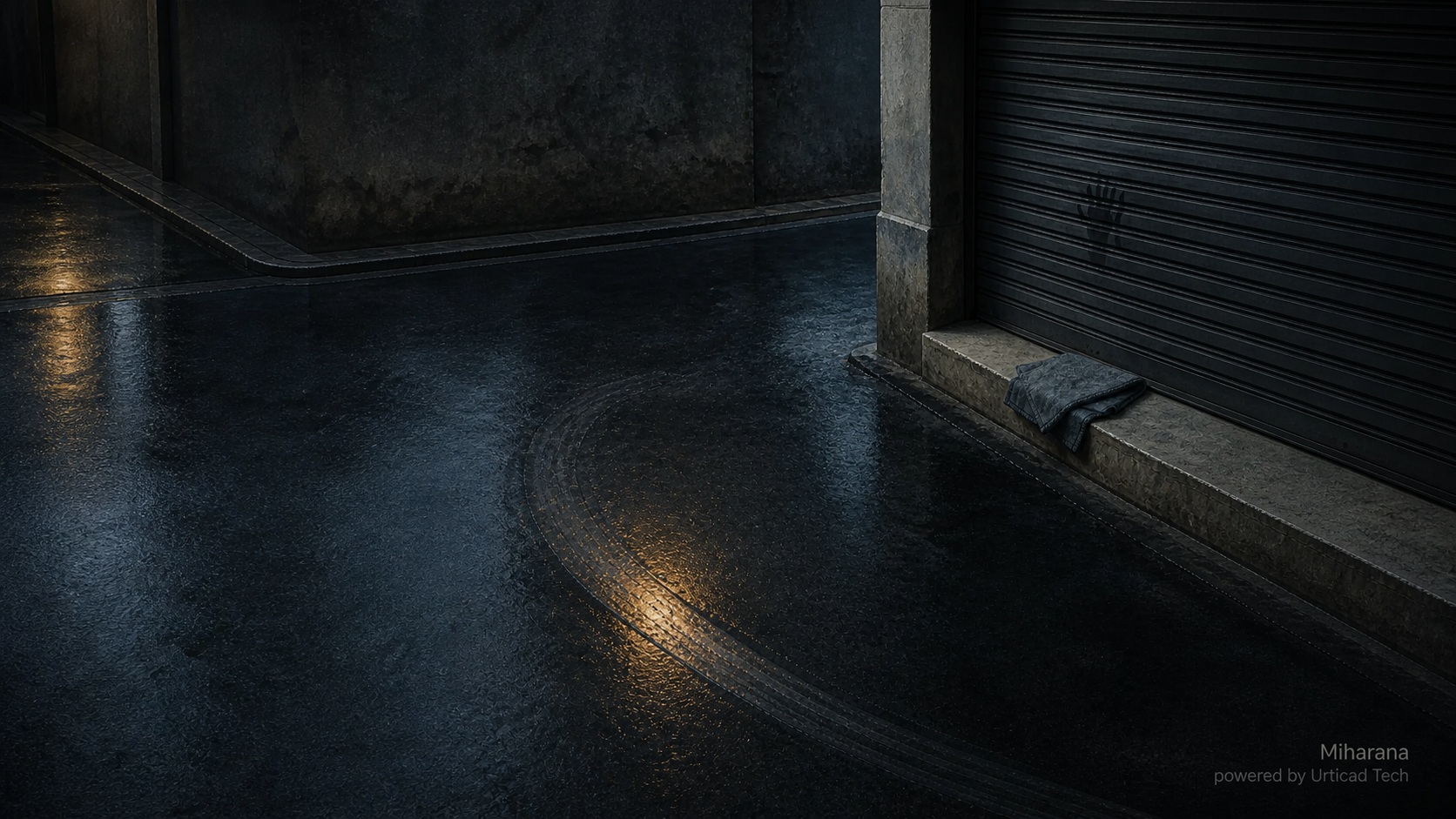
Miharana’s current Quiet Streets work Before the First Van offers a fitting visual metaphor. The gallery records it as human-led and AI-assisted. Its empty, rain-darkened street holds the moment before ordinary movement begins: not a promise that the first arrival wins, but a reminder that position is built before the street becomes crowded.
Early does not mean careless
OpenAI’s paper closes by arguing that adoption is only the beginning of deployment. The long-run effects depend on how people learn, invest in complementary capabilities and reorganise work around the technology.
Digital artists face the same choice. The strongest future position will not belong automatically to whoever generates the most images or adopts every model first. It is more likely to belong to artists who start early enough to build deep judgement, a coherent catalogue, credible routes to market and an evidence trail that keeps human authorship understandable.
AI can accelerate production. The more strategic opportunity is to let it compound the practice.
For artists, galleries and institutions exploring human-led, AI-assisted work, Miharana and Urticad are developing a quieter path through provenance, verification and collector-facing context.
Sources
- How Organizations Use AI: Evidence from ChatGPT, Chatterji et al., 12 August 2026.
- OpenAI B2B Signals: How frontier firms are pulling ahead, 6 May 2026.
- C2PA Content Credentials specification 2.4.
- Before the First Van — Quiet Streets, Miharana live gallery.
- Miharana by Urticad.