

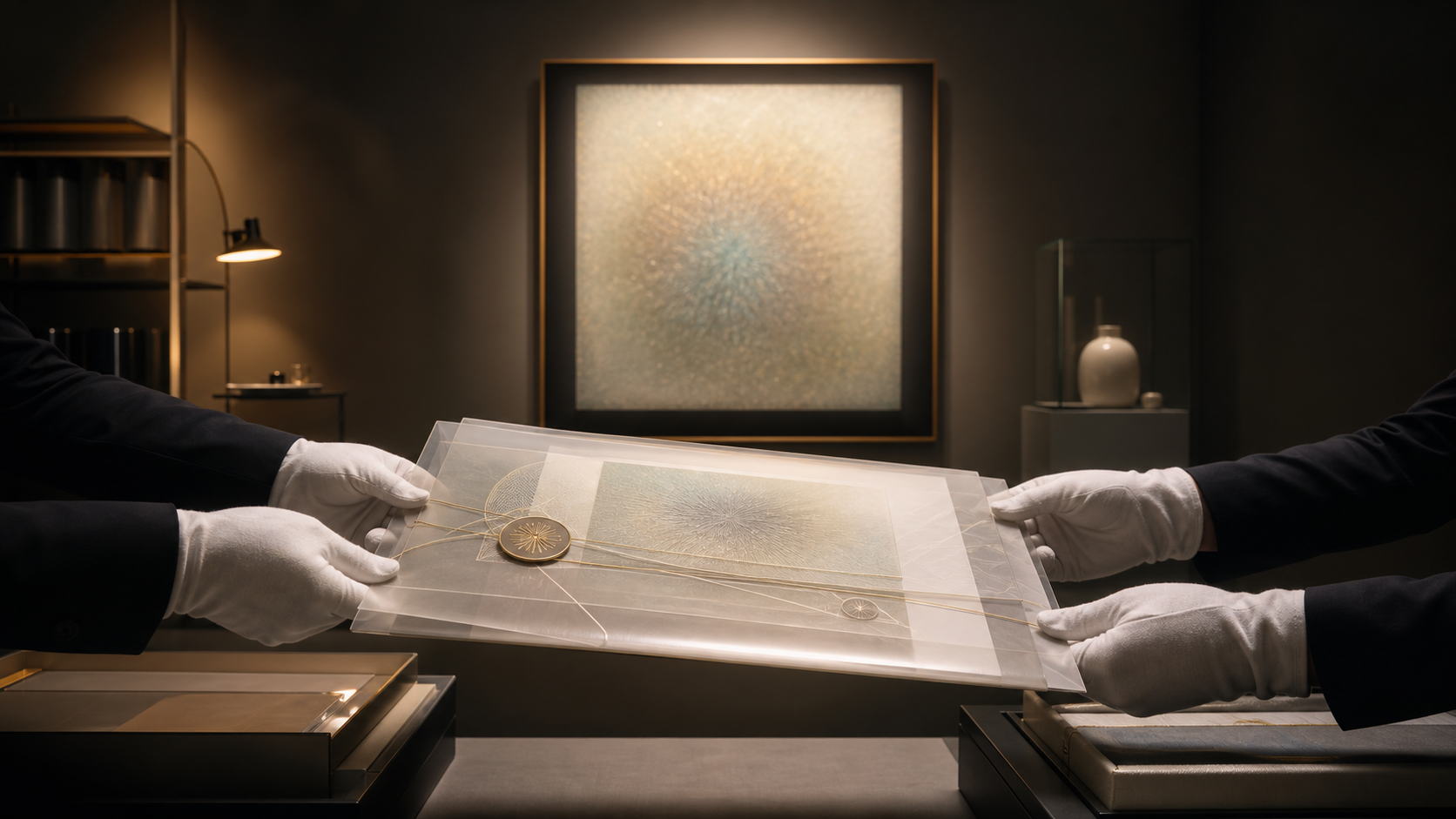
A digital artwork rarely stays in one system. It leaves an artist’s studio, arrives at a gallery, moves into an exhibition workflow, reaches a collector and may later be reviewed by a conservator, registrar or researcher. Every handover creates a practical question: what information should travel with the work so that the next person can understand what they have received?
The usual software answer is to build another dashboard. Ask the artist, gallery, institution and buyer to log in, learn a new interface and trust that the platform will still be available whenever the work is revisited.
That is a poor fit for the way cultural organisations actually work. The stronger answer is a portable evidence pack: a clear, proportionate set of records that can move with the asset and remain understandable beyond the interface that created it.
The handover is where provenance becomes operational
Provenance is often presented as a feature attached to a finished file. In practice, its value appears at moments of transfer.
A gallery may need to confirm which file is the controlled source and which version is approved for display. A curator may need to understand whether a supplied file is a viewing copy or the exhibition master. A registrar may need enough information to record what entered the collection. A collector may want a public way to check the work without gaining access to private studio material.
These are not identical questions, and they should not be answered by exposing everything to everyone. They require a structured handover in which evidence is useful to the recipient, appropriately limited and connected to the asset it describes.
Digital-preservation practice already treats this as serious operational work. The Digital Preservation Coalition’s handbook notes that metadata supports fixity during transfer as well as later preservation and access. Its storage guidance also recommends checksums, documentation of acquisition and transfer, provenance, and audit trails. That is a helpful discipline for the art market: integrity is not a single badge but a record that survives movement between responsible parties.
What belongs in an evidence pack?
The exact contents should depend on the work and the recipient, but a gallery-facing pack can be built around five questions.
First, what is this asset? The pack should identify the artwork, creator, file format and controlled record without relying on a filename alone.
Second, which file is being handed over? A cryptographic checksum can help the recipient compare the received file with the recorded one. It does not prove authorship by itself, but it provides a precise integrity check.
Third, how does this file relate to the work’s history? The C2PA specification provides a model for cryptographically bound provenance data. Its Content Credentials can contain assertions about an asset and actions in its history, while ingredient relationships can describe how one asset relates to another. C2PA validation can help determine whether those records remain bound to the asset and have not been altered; it does not make an aesthetic or moral judgement about the work.
Fourth, what may the recipient do next? The operational instruction should be unambiguous: for example, whether the supplied file is for review, display preparation or public release. This is not a substitute for a contract, nor should a technical record be presented as legal advice. It is a way to reduce preventable ambiguity in day-to-day handling.
Fifth, what can be checked publicly? A recipient should have a calm verification route that confirms the appropriate evidence without revealing private master files, personal data or internal notes.
Together, these elements form something more useful than a certificate screenshot. They give the next participant enough context to continue the workflow responsibly.
The pack should survive the product surface
Good software still matters. Interfaces make records easier to create, review and maintain. But an interface should not become the only place where meaning exists.
If a provenance record can be understood only while a particular subscription is active, the institution has inherited a dependency rather than received evidence. A portable pack should therefore use stable identifiers, exportable records, ordinary file formats where practical and links that complement—rather than replace—the underlying evidence.
This is also why public verification should be selective. A public page can show that a record exists, identify the work and present relevant provenance signals. It need not expose the master file, every internal transfer note or every personal detail associated with the creator. The evidence pack can contain different layers for different responsibilities, while preserving a coherent relationship between them.
How Miharana approaches the handover
Miharana by Urticad is being built as a gallery-grade path for digital art protection, provenance and public verification. Its public product material describes invisible watermarking, signed C2PA provenance and public verification, with the artwork kept visually first.
Those capabilities are most useful when treated as parts of a handover system.
An invisible watermark can provide a quiet link between a circulating image and its protected record. A C2PA credential can carry signed provenance information bound to an asset. A public verification surface can make selected evidence legible to galleries, representatives and collectors. The controlled record can keep the master-file context separate from the public copy.
None of these elements should be asked to do every job. A watermark is not the whole provenance history. A credential is not a legal deed. A public verification page should not reveal the private archive. Their value comes from coordination: each layer answers the question it is suited to answer, and the evidence pack explains how the layers relate.
For an artist, this means fewer improvised explanations each time a work moves. For a gallery, it means a more consistent intake and exhibition handover. For an institution, it offers a clearer starting point for documentation and preservation. For a collector or investor assessing the sector, it demonstrates that art technology can address ordinary operational risk rather than merely add novelty.
Infrastructure should make responsibility easier to carry
The future of digital-art provenance will not be won by the platform with the largest number of screens. It will be shaped by systems that help evidence remain intact, proportionate and intelligible as a work changes hands.
A gallery does not need another isolated dashboard. It needs to know what arrived, how it relates to the controlled work, what evidence supports it and what should happen next.
That is the standard a useful evidence pack should meet.
If you work with digital art in a studio, gallery, collection or cultural institution, Urticad would welcome a practical conversation about which evidence actually helps at the point of handover.